
WOODWARD 2301A Speed Control Controller: A Classic and Reliable Engine and Turbine Speed Control Solution
WOODWARD 2301A Speed Control Controller: A Classic and Reliable Engine and Turbine Speed Control Solution
Introduction
Accurate and stable control of the speed of the prime mover (engine, turbine) is crucial in key fields such as power generation, ship propulsion, and industrial drive. The Woodward 2301A speed controller, as a proven classic electronic speed control device, is widely used worldwide for speed and load control of diesel engines, gas engines, steam turbines, and gas turbines due to its sturdy structure, flexible configuration, and excellent reliability. This article provides a comprehensive analysis of the functions, installation, debugging, operation, and maintenance of the 2301A speed controller based on Manual 82020D.
Product Overview and Application Fields
1. Core functions
The 2301A speed controller is an electronic speed controller based on a printed circuit board. By monitoring the signal of a magnetic speed sensor (MPU) and comparing it with a reference speed set internally or externally, the controller outputs a control signal to drive a proportional actuator, thereby accurately adjusting the opening of the fuel or steam valve of the prime mover, achieving:
Isochronous mode: maintains constant speed operation, unaffected by load changes.
Droop mode: adjusts the speed proportionally according to the load, suitable for multi machine parallel or infinite power grid operation.
Load distribution: With the help of load sensors, precise load sharing can be achieved among multiple generators.
2. Main models and power supply
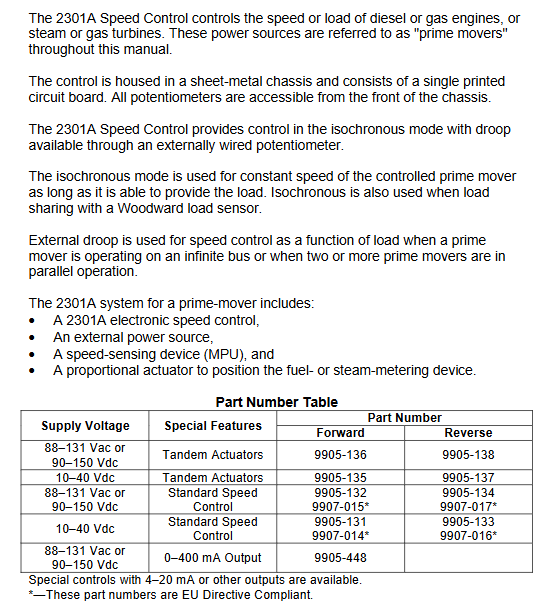
2301A offers multiple models to adapt to different applications:
Supply voltage special function forward acting model reverse acting model
88-132 Vac/90-150 Vdc series actuator 9905-136 9905-138
10-40 Vdc series actuator 9905-135 9905-137
88-132 Vac/90-150 Vdc standard speed control 9905-132/9907-015 * 9905-134/9907-017*
10-40 Vdc standard speed control 9905-131/9907-014 * 9905-133/9907-016*
88-132 Vac/90-150 Vdc 0-400 mA output 9905-448-
*Compliant with EU directive models.
The reverse acting system is designed specifically for applications equipped with Woodward EGB governors/actuators. In the event of electronic control failure, the mechanical backup governor can take over control, avoiding shutdown and improving system redundancy and safety.
Core points of installation and wiring
1. Power requirements
Low voltage model: 10-40 Vdc, low impedance power supply (such as battery) must be used, and it is strictly prohibited to draw power from high voltage sources through series resistors and Zener diodes.
High voltage models: 88-132 Vac (50-400 Hz) or 90-150 Vdc.
Important reminder: When disconnecting the battery, it is necessary to ensure that the charging device (such as the AC generator) is also disconnected from the control to prevent damage.
2. Shielding and grounding (key for EMI control)
All signal lines (MPU, actuators, auxiliary inputs, etc.) must use twisted pair shielded wires.
The shielding layer is only grounded at the controller end and connected to the chassis grounding bolt below terminal 9. The length of the grounding wire should be less than 5 centimeters.
The other end of the shielding layer must remain open and insulated, and must not be grounded at the sensor or actuator end.
Avoid laying signal lines in parallel with high current cables, and if necessary, use conduit or double-layer shielding.
3. External adjustment and options
Speed adjustment: Connect terminals 11-12 to a 100 Ω multi turn potentiometer, providing approximately ± 5% speed adjustment.
Sag adjustment: Connect terminals 13-15 to a 2k Ω potentiometer, providing a maximum sag of approximately 8%.
Minimum fuel contact point: used for normal shutdown, strictly prohibited from being used as part of emergency shutdown circuit.
Speed signal failure override: used in situations where there is no speed signal during startup (such as some steam turbines).
Idle/rated ramp contact: controls the switching between idle and rated speed, with adjustable ramp time (1-22 seconds).
Debugging and dynamic adjustment steps
1. Initial preset (before startup)
Rated speed potentiometer: Adjust counterclockwise to minimum.
Reset and gain potentiometer: placed in the middle position.
Slope time, low idle, droop (if used): Adjust counterclockwise to minimum.
Compensation for actuators:
Diesel engine/gas turbine: set to scale "2".
Steam turbine/carburetor gas engine: set to scale "6".
Start fuel limit: Adjust clockwise to maximum.
2. Startup and stability adjustment
Set the rated speed reference: The signal generator can be used to simulate the MPU frequency, or fine tune it after startup.
Check MPU signal: When turning, the voltage between terminals 7-8 should be ≥ 1.0 Vrms.
Stable operation adjustment:
Fast traveling car: Slowly decrease the gain counterclockwise.
Slow traveling car: increase reset clockwise; If it is ineffective, both the gain and actuator compensation can be fine tuned simultaneously.
Dynamic optimization:
Gradually increase the gain until the actuator becomes slightly unstable, and then reverse to stabilize.
Adjust the reset to reduce overshoot or adjustment time through sudden load/unload test response.
4. Key function adjustment
Low idle: At rated speed, open the "rated closed" contact and adjust the low idle potentiometer to the target idle speed.
Slope time: Adjust acceleration smoothness to avoid starting overspeed.
Starting fuel limit: Optimize the starting characteristics to ensure smooth starting and normal smoke exhaust.
Sag setting: Based on the requirements of parallel operation or isolated network operation, use a formula to accurately set the sag percentage.
Fault Diagnosis Guide (Abstract)
Possible causes of symptoms and solutions
The prime mover cannot start, the actuator does not operate, the polarity of the power supply is reversed, the voltage is low, or there is no power; Actuator malfunction; The fuel limit for starting is too low; No MPU signal; The lowest fuel contact is open circuit. Check the polarity voltage of the power supply; Check the actuator circuit and resistance; Adjust the starting fuel limit clockwise; Check the MPU signal voltage (≥ 1Vrms) and wiring; Check and close the lowest fuel contact.
The overspeed ramp time during startup is too short; The rated speed is set too high; Improper gain/reset adjustment; Engine malfunction. Increase slope time; Reset the rated speed; Optimize gain/reset dynamic adjustment; Check if the fuel rack is stuck.
Unstable operation (traveling block), improper adjustment of gain, reset, and actuator compensation; Speed setting potentiometer malfunction; Poor wiring shielding; The linkage mechanism is loose or stuck. Perform dynamic adjustments again; Check if the resistance of the potentiometer is stable; Ensure that all signal lines are properly shielded and grounded at a single point; Check the connection between the actuator and the fuel mechanism.
Unable to adjust the low idle setting below the mechanical minimum fuel position of the actuator at idle speed; Potentiometer malfunction. Increase the low idle setting or adjust the mechanical limit of the linkage mechanism; Replace the controller.
Product Support and Services
Woodward provides a multi-level technical support network:
OEM/Package Manufacturer Support: The best contact person for first-time programming and system integration issues.
Woodward Business Partners: including full-service distributors, authorized independent service facilities, and recognized engine modification providers, providing localized sales, service, and technical support.
Woodward direct support: available via email EngineHelpDesk@Woodward.com Or contact the Global Technical Support Center through the website.
The service options include: replacement/exchange (24-hour service), fixed rate repair, and fixed rate refurbishment.
When repairing equipment, it is necessary to obtain the repair authorization number in advance and provide a detailed description of the fault phenomenon and the type of repair required.
Summary of Safety Warning (must be followed)
Overspeed protection: The prime mover must be equipped with an overspeed shutdown device that is completely independent of the control system.
Emergency stop preparation: Emergency stop preparation must be made during startup to prevent runaway.
Personal protective equipment: Proper PPE (goggles, gloves, safety shoes, etc.) must be worn during operation.
Electrostatic protection: When handling circuit boards, it is necessary to follow electrostatic discharge prevention measures and contact the grounding surface.
Minimum fuel contact: Never use as an emergency stop circuit.
Summary
The Woodward 2301A speed controller is an industrial grade speed control device with mature design, complete documentation, and network support. Its successful application relies on correct installation and wiring, meticulous shielding and grounding, adherence to standard debugging procedures, and strict compliance with safety warnings. For engineers and technicians engaged in power generation, shipbuilding, industrial drive and other fields, mastering the installation, commissioning and maintenance skills of 2301A is an important part of ensuring the stable, efficient and safe operation of key power systems.
Model Supplement
8402-319 8402-119
8237-1600
9907-147
5233-2089
9907-1106
5453-203
5453-277
5466-318
5466-425
8440-1706 A SPM-D11
8440-1666 B
5437-1067A
5448-890 SPM-D10
- OMRON
- ABB
- General Electric
- EMERSON
- Honeywell
- HIMA
- ALSTOM
- Rolls-Royce
- MOTOROLA
- Rockwell
- Siemens
- Woodward
- YOKOGAWA
- FOXBORO
- KOLLMORGEN
- MOOG
- KB
- YAMAHA
- BENDER
- TEKTRONIX
- Westinghouse
- AMAT
- AB
- XYCOM
- Yaskawa
- B&R
- Schneider
- KONGSBERG
- NI
- WATLOW
- ProSoft
- SEW
- ADVANCED
- Reliance
- TRICONEX
- METSO
- MAN
- Advantest
- STUDER
- DANAHER MOTION
- Bently
- Galil
- EATON
- MOLEX
- DEIF
- B&W
- ZYGO
- Aerotech
- DANFOSS
- Beijer
- Moxa
- Rexroth
- Johnson
- WAGO
- TOSHIBA
- BMCM
- SMC
- HITACHI
- HIRSCHMANN
- Application field
- XP POWER
- CTI
- TRICON
- STOBER
- Thinklogical
- Horner Automation
- Meggitt
- Fanuc
- Baldor
- SHINKAWA
- Other Brands
- UniOP
- KUKA
- Iba
- Beckhoff
- ADLINK
-
 Sigmatek MDD111-1 DIAS Drive Axis Module
 -
 Sigmatek DKL042 05-024-042 Terminal Module
 -
 Sigmatek DM822 Control Module
 -
 Sigmatek CDM167 12-008-167-O Module
 -
 Sigmatek TAE151 Touch Display Unit
 -
 Sigmatek DCC041 SLIDES Module 05-700-041-D
 -
 Sigmatek AKM65M-ANC2GBB0 PM Servo Motor
 -
 Sigmatek ETT221 01-230-221 Operator Terminal
 -
 Sigmatek SLIDES DAM 124 Analog Module
 -
Sigmatek AKM31C-ANCNGBB0 Servo Motor
-
 Mannesmann Demag Sigmatek CP626 Central Unit
 -
 SIGMATEK 0332.554.03 Board 371071000154
 -
 SIGMATEK 12-250-021 Base Plate Back Panel CM5V020
 -
 SIGMATEK DM162 S-DIAS Digital Mix Module
 -
 DEMAG ERGOTECH 061 381 66 Sigmatek 9842.243.02 Circuit Board
 -
 SIGMATEK CP313-1 PLC Module
 -
Sigmatek ETV0551-2 VARAN Touch Terminal
-
 Sigmatek SDM 081 FS S-Dias Safety Module
 -
 DEMAG 05-250-023 Ergotech Motherboard with Sigmatek TMS012
 -
Sigmatek CM5V020 12-250-023-K Wiring Base
-
 Sigma Tek 5000B-37 Attitude Gyro Indicator
 -
 Sigmatek SDD120-2 DIAS Drive
 -
 Sigmatek CME221 Memory Module
 -
 Sigmatek DCP640 DIAS Central Unit
 -
 Sigmatek STO040 Safety Output Module
 -
Sigmatek CET281 Control Panel
-
 Sigmatek CIPC LX800 Demag NC5 CPU
 -
 Sigmatek DKL093 05-024-093 Terminal Module
 -
 Sigmatek AI088 20-009-088 Analog Input Module
 -
Sigmatek CAI888 Analog Input Module
-
SIGMATEK CCA021 12-025-021 Analog Output Module
-
SIGMATEK 1104.579.05 Control Module
-
SIGMATEK SDI100 Digital Input Module
-
 SIGMATEK C-IPC 256MB LX800 Compact Dias
 -
 SIGMATEK 9423.090.02 Control Module
 -
SIGMATEK C-IPC 256 Power Supply 148498
-
 SIGMATEK CAI025 Analog Input Module
 -
 SIGMATEK CTO166 Digital Output Module
 -
 SIGMATEK CP112 20-004-112 Processor Module
 -
SIGMATEK CAI887 12-009-887 Safety Module
-
 Sigma-Tek 4000B-31 Directional Gyro 1U262-002-42
 -
Sigmatek C-IPC 256MB LX800 IPC Controller
-
Sigmatek C-IPC 01-450-031 Industrial PC LX800
-
Sigmatek C-IPC 256 Industrial PC Controller
-
Sigmatek CCP-531 PLC Processor Module
-
Sigmatek CDI163 Digital Input Module
-
 Sigmatek ETV0501 VARAN Terminal 12-230-0501
 -
 Sigmatek CTMS020 C-DIAS Technology Module
 -
 Sigmatek CIV512 VARAN Switch Module
 -
 Sigmatek HU011 20-080-011 Interface Module
 -
SIGMATEK SLIDES DAM 124 Module
-
 SIGMATEK C-IPC 161 01-450-161L Industrial PC
 -
SIGMATEK C-IPC 128MB VIA 733MHz 01-450-024-K
-
 SIGMATEK 12-780-012 R8-IPC Geode LX800 Module
 -
SIGMATEK CAM124 Analog Module
-
 SIGMATEK S1 032-8AF61-R4 EZ Servo Motor
 -
 SIGMATEK CTO163 Digital Output Module
 -
 SIGMATEK CCP082 12-004-082 Processor Module
 -
 SIGMATEK CRCH081 C-DIAS Temperature Module
 -
 SIGMATEK PC322-K 01-310-322-K Industrial PC
 -
SIGMATEK SDD310-2 Servo Drive
-
 SIGMATEK AI084 Analog Input Module
 -
SIGMATEK CRCH081 12-752-081 Temperature Module
-
Sigma-Tek 5000L-4 Attitude Gyro 1U284-001-3
-
 SIGMATEK CM5V020 12-250-023-K Wiring Module
 -
Sigma-Tek 4000H-6 Directional Gyro IU262-035-7
-
 SIGMATEK Dias DCP160 05-004-160 Processor Module
 -
SIGMATEK 0147.395.02 Control Module
-
SIGMATEK A1084 Control Module
-
SIGMATEK DI200 20-006-2000 Digital Input Module
-
Sigmatek DNC115 Encoder Module
-
 Sigmatek DAM122 05-017-122 Analog Module
 -
Sigmatek 9802.289.01 Control Board TA71 Display
-
Sigmatek TO127 20-007-127 Digital Output Module
-
Sigmatek DNC031 05-011-031 Digital Module
-
Sigmatek VI022 20-003-022 Interface Module
-
Sigmatek CAI085 Analog Input Module
-
 Sigmatek CP111 S-DIAS CPU Module
 -
Sigmatek CTMS030 Krauss Maffei Module
-
 Sigmatek CAM123 Control Module
 -
 Sigmatek TAE732-P 01-240-732-P Touch Display Unit
 -
Sigmatek MDM021 Digital Mixed Module
-
Sigmatek DCP642 DIAS Central Unit
-
 Sigmatek CST022 12-014-022 C-DIAS Module
 -
 Sigmatek SRO021 20-893-021 Safety Relay Output
 -
 Krauss Maffei MC5 Control System Sigmatek
 -
 Sigmatek DC061 Module 18-24VDC 300mA
 -
 Herrmann EVT0855 Ultrasonic Welder Touch Panel
 -
Sigmatek CIV521 Control Module 1.4A 2W
-
Sigmatek DDI61 05-006-161 Digital Input Module
-
SIGMATEK ETT312-E Touch Terminal 01-230-312
-
Cessna S3326-1 Sigma Tek 5000B-67 Gyro 1U149-015-9
-
SIGMATEK PS101 Power Supply Module
-
SIGMATEK 0332.554.03 Control Module 371071000154
-
 SIGMATEK ETT312-E Touch Terminal 01-230-312
 -
SIGMATEK CDM163 Control Module
-
 SIGMATEK VSV046 16-023-046 Module
 -
SIGMATEK AM221 20-017-221 Analog Module
-
SIGMATEK CTS051 12-053-051 Control Module
-
SIGMATEK AM221 20-017-221 Analog Module
-
Sigmatek CSDI161 12-891-161 Safety Input Module
-
Sigma Tek 4000C-1 Directional Gyro Indicator
-
Sigmatek ETV0501 12-230-0501 VARAN Terminal
-
Sigmatek DDM165 SLIDES Module
-
Sigmatek N100 20-011-100 Control Module
-
Sigmatek AKM54K-ANC2R-B0 PM Servo Motor
-
Sigmatek CTO166 Digital Output Module
-
Sigmatek CP212-K 20-004-212-K CPU Module
-
Sigmatek CDI161 Digital Input Module
-
Sigmatek DCC080 05-700-080-2 Control Module
-
 SIGMATEK SCP011 S-DIAS Safety CPU
 -
SIGMATEK SCP011 S-DIAS Safety CPU
-
SIGMATEK SRO022 Relay Output Module
-
SIGMATEK MDD 121 Drive Axis Module
-
SIGMATEK DSI021 SLIDES Siemens Interface
-
SIGMATEK DIAS DCP161 Module 05-004-161
-
 Sigmatek ETT312 Built-in Touch Terminal
 -
SIGMATEK DCP 643 DIAS Controller System
-
SIGMATEK CIO021 Multi I/O Module
-
SIGMATEK CTMS020 Control Module
-
 Sigmatek CME 221 Memory Module
 -
Sigmatek 0420.615.01 Control Board
-
Sigmatek CP111 20-004-111 CPU Module
-
Sigmatek 9405.065.03 Control Board
-
Sigmatek ETEK 01-450-032-K C-IPC 256MB Industrial PC
-
Sigmatek CTO163 12-007-163 Safety Output Module
-
Sigmatek TO081 20-007-081 Digital Output Module
-
 Sigmatek SI021 20-022-021 Safety Input Module


